Content Creation (Media, Broadcast and Production) - T Level (Pearson)

Start Date:
2 September 2026
Centre:
Soho
Attendance:
Full Time
Time of Day:
Daytime
Duration:
2 Years
Qualification Type:
T Level
Level:
Level 3
Most suitable for:
16 - 18
Course Code:
40119

CAREER PROSPECTS
Graphic and Multimedia Designers
Photographers, Audio-visual and Broadcasting Equipment Operators
ABOUT
Content Creation (Media, Broadcast and Production) - T Level (Pearson)
This course will be delivered at the newly refurbished Soho centre, in the heart of London's Digital and Creative economy. This is an exciting new addition to Capital City College.
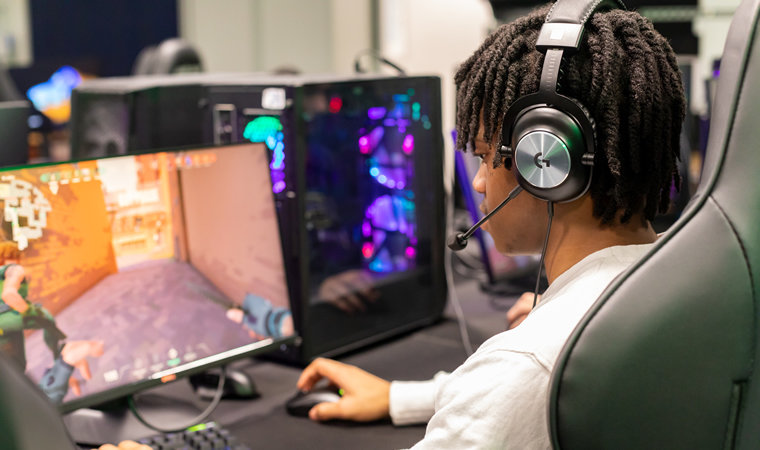
Our bespoke building will provide unparalleled facilities tailored for the creators and innovators of tomorrow, enabling learners to hone their craft on industry-standard equipment and develop the skills that the industry desperately needs.
The centre boasts industry-leading equipment and state-of-the-art training spaces, including:
- Green Screen Studio
- Animation Studio
- Virtual Production Suite
- Edit, Grade, Dub and Voice-Over Studio
- Podcast Studio
- TV Studio and Control Room
- Lecture Theatre
- Comprehensively Equipped Alienware Animation Studios.
The repurposed Soho centre will act as a beacon for world-class Creative and Digital sector provision, providing a talent pipeline of qualified and experienced individuals to access the fantastic career opportunities in these sectors.
The T Level Technical Qualification in Media, Broadcast and Production has two mandatory components.
Core Components - This component covers the underpinning knowledge, concepts and skills that support threshold competence in the media industry. You will be undertaking research, generating Ideas, communicating Ideas, developing ideas, working collaboratively with others and reflective practice. There are two assessments in the core component of the T Level qualification in Media, Broadcast and Production -
- Core Examination - Written examination worth 120 marks, 60% of the core assessment.
- Employer Set Project - An externally assessed project worth 132 marks, 40% of the core assessment.
Occupational Specialism - The Occupational Specialist's knowledge and skills are required to demonstrate threshold competence for content creation and production. The Occupational Specialism is assessed by a skills-related project that synoptically assesses the performance outcome skills and associated underpinning knowledge. Externally set project worth 240 marks, 100% weighting.
You will complete a minimum of 315 hours as part of your qualification in the industry on placement, which equates to 20% of your learning, and for the other 80% of the T Level, you will be learning in a classroom.
Embedded within the T Level will be English, Maths and Digital skills, weekly tutorials.
WHAT WILL I STUDY?
This T Level, offered by Pearson, will provide you with a comprehensive understanding of content creation and production within the dynamic media industry. This course is meticulously crafted to equip learners with the practical skills, theoretical knowledge, and industry insights necessary to excel in roles related to media, broadcast and production.
Key Modules
Fundamentals of Content Creation and Production:
- Introduction to the core principles of content creation, including audience analysis, storytelling techniques, and narrative structures
- Exploration of media production processes, encompassing pre-production planning, production execution, and post-production editing
Media Production Techniques:
- Practical training in camera operation, lighting setups, sound recording, and editing software applications
- Hands-on experience with industry-standard equipment and technologies used in media production environments
Scriptwriting and Storyboarding:
- Development of scriptwriting skills, focusing on script formatting, dialogue writing, and character development
- Training in storyboarding techniques to visualise and plan media projects effectively
Visual and Graphic Design in Media:
- Introduction to visual design principles and graphic design software tools commonly used in media production
- Exploration of techniques for creating engaging visual elements, animations, and special effects to enhance media content
Broadcast Technologies and Equipment:
- Overview of broadcast technologies, including studio cameras, lighting systems, audio equipment, and editing software platforms
- Practical sessions to familiarise students with the operation and maintenance of broadcasting equipment
Project Management and Collaboration:
- Acquisition of project management skills is essential for organising and executing media projects
- Emphasis on teamwork, communication, and collaboration within a creative production environment
Industry Insights and Professional Development:
- Engagement with industry professionals through guest lectures, workshops, and industry visits
- Opportunities for students to develop professional skills, network with industry contacts, and stay abreast of current trends and developments
ENTRY REQUIREMENTS
You will need:
- 5 GCSEs at 9-4, inclusive of English and Maths
- Successful interview and assessment
COURSEWORK REQUIREMENTS
All assessments are externally set and marked by Pearson.
The core and ESP components are externally set and marked by Pearson.
The OS components are set by Pearson. These are marked by the Provider and then moderated by Pearson
A distinctive aspect of this course is the incorporation of an extensive industry placement, enabling students to apply theoretical learning in practical settings. These placements provide invaluable exposure to the workings of production environments, allowing students to learn from experienced professionals, understand industry practices, and develop crucial employability skills.
FEES
AGED 16 - 18
If you will be aged 16, 17 or 18 on 31st August 2025 before the start date of the course, and you have the legal right to remain in the UK for the duration of your course then your study with us will be free.
Please see here for the documents you need to show us.
Some courses have additional costs, such as specialist materials and trips.
Many of our students are eligible for financial support. See here for details.
PROGRESSION
Job roles could include:
• Operating broadcast systems in TV/radio
• Outside broadcast operation and outdoor transmission
• Audio production assistant
• Broadcast assistant
• Production management assistant
• Programme assistant
• Runner
• TV production assistant
• Junior content assistant
• Social media assistant/coordinator
• Junior media executive
• Junior events and venues technician
• Live events production assistant
Alternatively, you could progress to Level 3 Apprenticeships such as those mentioned above to develop and gain certification of full occupational competence, or they could progress to higher-level Apprenticeships such as the Level 4 Postproduction Technical Operator, Assistant Technical Director (visual effects), Media Production Co-Ordinator and Assistant Recording Technician depending on their skills or experience.
There is also an option to progress to relevant Higher National Certificate (HNC) or Higher National Diploma (HND) programmes or degree programmes.
CAREER PROSPECTS
Graphic and Multimedia Designers
Photographers, Audio-visual and Broadcasting Equipment Operators